domingo, 13 de septiembre de 2009

Alcázar (13): La escalera del Palacio Alto.


El edificio de la Casa de la Contratación tiene una parte alta que es denominada como "Palacio Alto". Desgraciadamente no puedo mostraros imágenes de este palacio pero si puedo enseñaros su hermosa escalera adornada con un estupendo tapiz.
Constituyen las habitaciones que se encuentran en la planta superior del Palacio Mudéjar, fueron ampliados y transformados en tiempos de los Reyes Católicos, lo que incluyó la sustitución de techumbres del piso inferior que al ser a dos aguas, se conviertieron entonces en planas para soportar el suelo de la estancia superior.


Estas habitaciones no son visitables, quedando al uso privado de la familia real. Las estancias más destacados que se encuentran en esta planta superior son: El oratorio de los Reyes Católicos y altar de la Visitación original del ceramista Francisco Niculoso Pisano; La galería Altas del Patio de las Doncellas; y La cámara de la Reina.

Alcazar (13): The High Palace Stairs.

The building of the House of the Contracting takes a high part that is named as a "High palace". Unfortunately I cannot show you images of this palace but if I can show you his beautiful stairs adorned with a marvellous tapestry.
They constitute the rooms that we can find in the top floor of the Mudejar Palace, they were extended and transformed into times of the Catolics Kings, which included the substitution of roofs of the low floor that to the being to two waters.


These rooms are not visitables, staying to the private use of the Royal family. The most emphasized stays that they are in this top floor are: The oratory of the Catolics Kings and altar of the original Visitación, from the ceramist Francisco Niculoso Pisano; The High Ggallery of the Court of the Ladies; and The chamber of the Queen.

sábado, 12 de septiembre de 2009

Alcázar (12): El Patio de los Poetas.


El "Patio de los Poetas" o también llamado "Patio de Joaquín Romero Murube" en honor a uno de los antiguos Conservadores del Alcázar está situado en la Casa de la Contratación y se accede a él fácilmente a través del Patio de los Levíes.


Es un rincón intimista donde destacan algunas plantas, una fuente en el suelo y un banco junto la fuente donde descansar bajo el alegre sonido del agua.


Alcazar (12): The Poets Court.

The " Court of the Poets " or also so called " Joaquín Romero Murube's Court " in honor to one of the former Conservatives of the Fortress is placed in the House of the Contracting and we can go into it easily across the Court of the Levíes.
It is a intimist corner where some plants , a fountain in the soil and a bank next to the fountain where to rest under the happy sound of the water stand out.

viernes, 11 de septiembre de 2009

Alcázar (11): El Patio de los Levíes.


El Patio de los Levíes es uno de los patios traseros de la Casa de la Contratación. Recibe su nombre porque la arquería manierista que nos encontramos a su entrada procede de la Casa de los Levíes situada en el barrio de la Judería, a pocos pasos del Alcázar.


En el centro del patio hay una alberca con peces de colores y pequeñas plantas acuáticas. En los laterales más largos de la alberca hay dos setos de plantas que la protegen.
Sobre la pared del fondo hay una fuente con una cara esculpida en piedra en la pared de la que brota el agua.


Alcazar (11): The Levies´s Court.

The Court of the Levíes is one of the back courts of the House of the Contracting.
It receives its name because of the gallery of manierist arches that are at the entry. This gallery comes from the House of the Levíes placed in the neighborhood of the Jewry, a few steps from the Alcazar.


In the center of the court there is a pond with goldfishes and small water plants. In the longest wings of the pond there are two hedges of plants that protect it.On the wall of the bottom there is a fountain with a face in stone in the wall where the water sprouts.


jueves, 10 de septiembre de 2009

Alcázar (10): El Patio del Asistente.


El Patio del Asistente es uno de los patios que conforman la parte trasera de la Casa de la Contratación. Actualmente allí está situado el Museo del Azulejo Sevillano, con unas piezas verdaderamente valiosas, históricas y llamativas.
El Patio está compuesto por una parte baja que tiene una galería de columnas toscanas de mármol, y una parte alta que servía de vivienda.
Era la vivienda del "Asistente Corregidor", el representante del Rey en la ciudad de Sevilla.


Alcazar (10): The Asistant Court.

The Court of the Assistant is one of the courts that conform the back part of the House of the Contracting.
Nowadays there is placed the Museum of the Sevillian Blue roller, with a few really valuable, historical and showy pieces.
The place is composed by a littel court that has a marble toscan column gallery, and a high part that was using as housing.
It was the housing of the " Assistant Sheriff ", the representative of the King in the city of Seville.


miércoles, 9 de septiembre de 2009

Alcázar (9): El Patio del Cuarto Militar.

.


A la derecha del "Patio del León" y dentro del edificio de la "Casa de la Contratación" nos encontramos con este pequeño patio llamado "Cuarto Militar".
En su centro hay una fuente de mármol de ocho lados y alrededor una galería porticada.


Alcazar (9): The Military Court.
.
To the right of the "Court of the lion" and inside the building of the "House of the Contracting " we meet this small court called "Military Court".
In its center there is a fountain in marble of eight sides and around a gallery with arches.

martes, 8 de septiembre de 2009

Alcázar (8): La Sala Capitular.

.


La Sala Capitular o Capilla está junto a la Sala del Almirante. Es de planta cuadrada, cubierta con una rica techumbre del siglo XVI de tracería con adornos geométricos y paredes forradas en tela con los escudos de armas de las familias relacionadas con los negocios con América.
Destaca en una de sus paredes el impresionante retablo pictórico de la Virgen de los Navegantes, obra de Alejo Fernandez de 1535. Es un cuadro digno de una detenida observacion , pues en las partes laterales tenemos a San Telmo, San Sebastian, San Juan y Santiago Matamoros.


Cobijados por el manto de la Virgen diferentes personajes del descubrimiento y conquista de América, como Cristóbal Colón, Americo Vespucio, Juan de la Cosa, etc.
Allí podemos ver también una réplica en miniatura de la Nao Santa María, la nave capitana que descubrió América y un baúl que, se supone, perteneció a al Almirante Cristóbal Colón.
La Sala Capitular era la estancia utilizada por los pilotos de barcos y los geógrafos para realizar sus tareas.
.
.
Alcazar (8): The Chapterhouse.
.
The Chapterhouse or Chapel is close to the Room of the Admiral. It has a square floor covered with a rich roof of the 16th century of tracería with geometric adornments and walls lined in fabric with the shields of weapon of the families related with the business with America.
Stands out in one of its walls the impressive pictorial altarpiece of the Virgin of the Navigators, Alejo's Fernandez work from 1535. It is a worthy picture of an slow observation, since in the lateral parts we have San Telmo, San Sebastian, San Juan and Santiago Matamoros.


Sheltered by the mantle of the Virgin different prominent figures of the discovery and conquest of America, as Christopher Colón, Americo Vespucio, Juan de la Cosa, etc.
There we can see also a reply in miniature of the Vessel Santa Maria, the ship flagship that discovered America and a trunk that, it is supposed, it belonged to to the Admiral Christopher Colon. The Chapterhouse was the stay used by the pilots of ships and the geographers to realize his tasks.
.

lunes, 7 de septiembre de 2009

Alcázar (7): La Sala del Almirante.

.


A la derecha del Patio de la Montería nos encontramos con el Palacio llamado Casa de la Contratación, aunque el palacio no recibió este nombre hasta 1503 en honor al lugar donde se contrataban los negocios con América, el continente recién descubierto.
Antes era un palacio que mandó construir el Rey almohade Al-Mutamid quien le dio el romántico nombre de Alcázar Bendito.
Esta Casa de la Contratación se divide en tres partes: la Sala del Almirante que hoy día sirve de lugar de conferencias; la Sala Capitular o Capilla, de la que hablaremos mañana; y la Sala de los Abanicos, una especie de pequeño museo donde se hace honor a tan refrescante elemento.
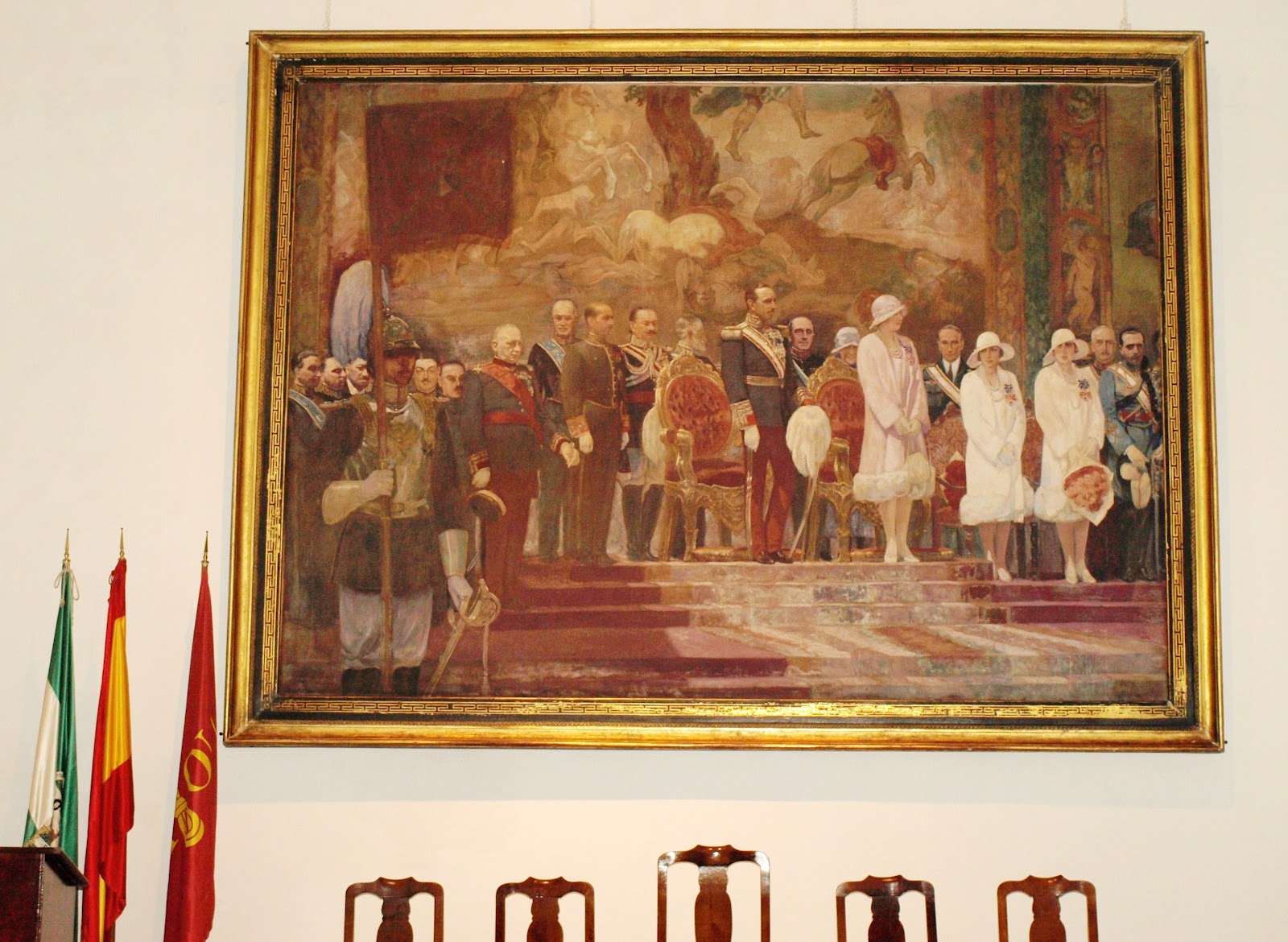
En los muros de la Sala del Almirante destacan cuadros importantes de épocas diversas. En uno de ellos se muestra a San Fernando, el patrón de la ciudad.
.

.
Alcazar (7): The Admiral´s Room.
.
To the right of the Court of the Hunt we meet the Palace called House of the Contracting, though the palace did not receive this name until 1503 in honor to the place where the business were contracted by America, the continent newly disclosed.
Before it was a palace that gave the orders for constructinged the almohade King Al-Mutamid who gave the romantic name of Blessed Fortress.
This House of the Contracting is divided in three parts: the Admiral´s Room who today is used like a conferences´s place; the Chapterhouse or Chapel, about which we will speak tomorrow; and the Room of the Ranges, a kind of small museum where honor is done to so refreshing element.
In the walls of the Room of the Admiral stand out important pictures of diverse epochs. In one of them Saint Fernando, the religious lord of Seville.