lunes, 28 de noviembre de 2011

La Copa Davis.


En los próximos días 2, 3 y 4 de Diciembre, se celebrará en Sevilla la final de la Copa Davis de este año 2011.
La final será disputada por España (Nadal, Ferrer, Feliciano López y Fernando Verdasco) contra Argentina (Del Potro, Mónaco, Nabaldián...) en el Estadio de La Cartuja.
Mientras tanto, en la Sala Capitular de nuestro Ayuntamiento podemos ver un pequeño museo del tenis y de la Copa Davis.
En este museo sobresale, y de qué manera, la misma copa que podrá llevarse el ganador de la final.


In the next 2nd, 3rd and 4th of December, there will be celebrated in Seville the Davis Cup final of this year 2011.
The final will be disputed by Spain (Nadal, Ferrer, Feliciano Lopez and Fernando Verdasco) against Argentina (Del Potro, Mónaco, Nabaldián ...) in La Cartuja Stadium.
Meanwhile, in the Chapterhouse of our Town hall we can see a small museum about the tennis and the Davis Cup.
In this museum it stands out  the same Davis Cup that the winner of the final will be able to take.

domingo, 27 de noviembre de 2011

Concurso de Arte Urbano.


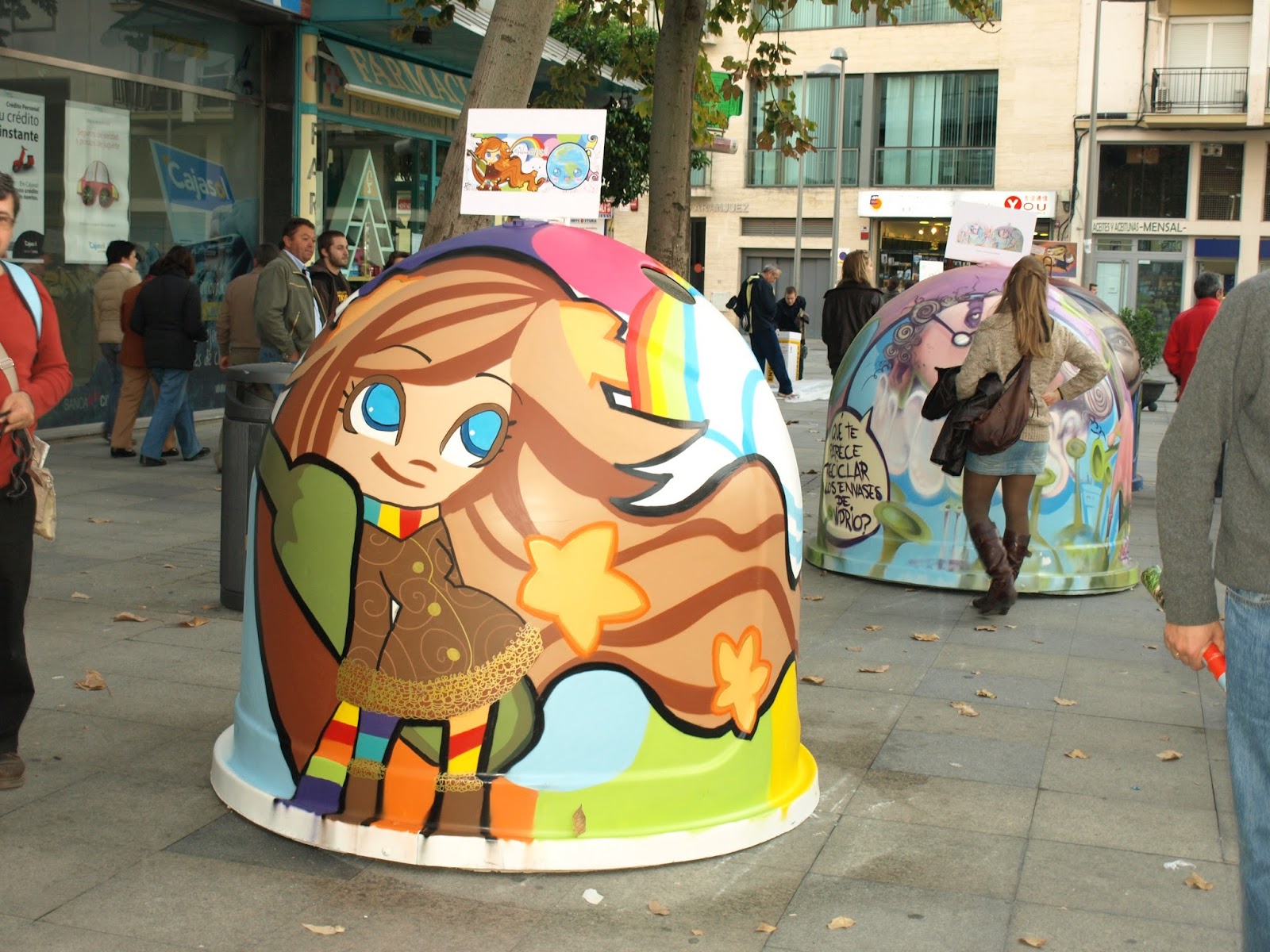
En el día de ayer, en la Plaza de la Encarnación, se celebró el 4ª Concurso de Arte Urbano organizado por el Ayuntamiento de la ciudad y la empresa de limpieza municipal Lipasam.
Eran 30 chicos los participantes, quienes tenían que pintar un contenedor de envases de vidrio en directo en base a un boceto que había sido preseleccionado.
Estos contenedores se instalarán en toda la ciudad a partir de la semana que viene.
Aquí podemos ver alguno de los trabajos de los graffiteros de nuestra ciudad.


Yesterday, in Encarnacion Square, was celebrated the 4th Urban Art Trophy organized by the Goverment of the city and the cleanliness company Lipasam.
The participants were 30 boys and girls, who had to paint a glass bottle container while the public see the work.
These containers will establish in the city next week.
Here we can see some works of the graffiters of our city.

.
.
.
.
.
.
.
.
.
.
.
.
.
.

sábado, 26 de noviembre de 2011

La Glorieta de Luca de Tena.


Don Torcuato Luca de Tena murió en el año 1929, el mismo año en el que se celebró la Exposición Iberoamericana en nuestra ciudad. Coincidiendo ambos acontecimientos, Sevilla decidió hacerle un homenaje ese mismo año para perpetuar su figura, su obra y el agradecimiento eterno de los sevillanos hacia el señor Luca de Tena.
Pero como todo, en Sevilla, los tiempos se miden de forma distinta al resto del mundo. El monumento que ustedes ven en la foto se inauguró veinticinco años después.
Frente a la Plaza de España hay una pequeña glorieta en la que podemos ver el busto de Luca de Tena en bronce realizado por el artista Emilio Laiz Campos, delante de él hay una pequeña fuente y detrás un edificio con jaulas para pájaros que están decoradas con frescos de motivos avícolas.
El busto lleva la leyenda "Sevilla a D. Torcuato Luca de Tena y Álvarez Ossorio (1861-1929)".
don Torcuato luca de Tena, hijo de una familia industrial sevillana, fue fundador del diario ABC, de la revista Blanco y Negro y fue el primer Marqués de Luca de Tena, nombrado por Alfonso XIII.


Don Torcuato Luca de Tena died in 1929, the same year in which the Latin-American Exhibition was celebrated in our city. Coinciding both events, Seville decided to make honoring him the same year to perpetuate his figure, his work and the eternal gratefulness of the Sevillian people towards the gentleman Luca de Tena.
But as everything, in Seville, the times measure up differently to the rest of the world. The monument that you see in the photo was inaugurated twenty-five years later.
Opposite to Spain Square there is a small place in which we can see Luca de Tena's bust realized by the artist Emilio Laiz Campos, in front of it there is a small fountain and behind a building with cages for birds that are decorated with poultry motives.
The bust takes the legend "Seville to D. Torcuato Luca de Tena and Álvarez Ossorio (1861-1929)".
Don Torcuato luca de Tena, son of an industrial Sevillian family, was a founder of the diary ABC, of the magazine Whitly and Black and was the first Marquess of Luca de Tena, named by Alfonso XIII.

viernes, 25 de noviembre de 2011

Al-Mutamid, el Rey poeta.


En el Alcázar sevillano, entre muchos de sus hermosos jardines está el Jardín de la Galera, llamado así porque en él había unos setos que tenían forma de galera y que simulaban cañonearse con chorros de agua.
En dicho jardín hay una columna de mármol conmemorativa del noveno centenario (1091) del destierro del Rey Al-Mutamid de Sevilla hacia Marruecos donde murió cuatro años después.
Al-Mutamid fue rey de taifas en Sevilla desde el año 1060 hasta su destierro. Al-Mutamid fue también un notable poeta y, durante su reinado, la cultura floreció en Sevilla.
En su corte gozaron de favor los poetas y literatos, como el siciliano Ibn Hamdis, Ibn al-Labbana o el propio visir y poeta Ibn Ammar de Silves.


De su amor por la poesía cuenta la leyenda que paseando un día a orillas del Guadalquivir con su amigo Ibn Ammar, jugaban a improvisar poemas, entretenimiento extremadamente popular en la sociedad andalusí de la época. Al levantarse una ligera brisa sobre el río, dijo Al-Mutamid: "El viento tejiendo lorigas en las aguas".
Ante lo cual esperaba la respuesta de su compañero. Sin embargo, Ibn Ammar no tuvo tiempo de responder, puesto que ambos oyeron una voz femenina que completaba la rima:"¡Qué coraza si se helaran!".
La voz correspondía a una muchacha escondida tras los juncos. Era una joven bellísima llamada Rumaikiyya, esclava de un arriero.
Al-Mu‘tamid quedó inmediatamente enamorado, la llevó a su palacio y la hizo su esposa, tomando el nombre de Itimad (hoy día una asociación artístico-literaria de Sevilla lleva este nombre). Cuando Al-Mutamid fue depuesto, Itimad partió con él al exilio.


In the Sevillian Alcazar, between many of its beautiful gardens, the Galley Garden is, called like that because in it there were a few hedges that look like galleys and that they were simulating to be shelled by water jets.
In the above mentioned garden there is a commemorative marble column about the ninth centenary (1091) of the exile of the King Al-Mutamid of Seville towards Morocco where he died four years later.
Al-Mutamid was a king in Seville from the year 1060 up to his exile. Al-Mutamid was a notable poet too and, during his reign, the culture bloomed in Seville.
In his court the poets and writers got the royal favor, as the Sicilian Ibn Hamdis, Ibn al-Labbana or the own visir and poet Ibn Ammar de Silves.

jueves, 24 de noviembre de 2011

La Mezquita de los Osos.


En la Plaza Virgen de los Reyes nos encontramos con el Convento de la Encarnación.
Este convento se asentó sobre el edificio del antiguo Hospital de Santa Marta que lo ocupó desde 1260, poco tiempo después de conquistarse la ciudad por las tropas castellanas y cristianas.
Antes de ser hospital, este edificio fue una mezquita, pequeña, porque era simplemente para los rezos de los habitantes del barrio (la mezquita grande la tenían justo enfrente, lo que es actualmente la Catedral).
Se conservan pocos restos de esta edificación, que se pueden ver en el exterior de la iglesia conventual: en la cabecera del templo, entre la plaza de la Virgen de los Reyes y el callejón de la Plaza de Santa Marta, se ven unos arcos ciegos polilobulados que son lo más reconocible de la antigua mezquita.
A la Mezquita se le dio el nombre castellano de "Mezquita de los osos". Realmente no se conoce el origen de dicha nomenclatura, pero se supone que fue porque de esa manera sonaría el vocablo árabe que designaba a la mezquita y no porque hubiera osos en algún lugar del edificio.


In Virgen de los Reyes Square we meet the Convent of the Incarnation. This convent is on the building of the former Hospital of Holy Martha that occupied this place from 1260, a little time after the city was conquered by the Castilian and Christian troops.
Before being a hospital this building was a mosque, small, because it was simply for the prayers of the inhabitants of the neighborhood (they had the big mosque just in front of the small mosque, which is, nowadays, the Cathedral).
There remain few parts of this building, which can be seen in the exterior of the conventual church: in the head-board of the temple, between Virgen de los Reyes Square and the alley of Santa Marta Square, there see a few blind arches that are the most recognizable elements of the former mosque.

miércoles, 23 de noviembre de 2011

El patio del Hospital de los Venerables.


La conocida Plaza de los Venerables debe su nombre al no menos conocida (aunque sí menos visitado) Hospital de los Padres Venerables.
En la actualidad, el edificio pertenece a la Fundación Focus-Abengoa y en él está instalado el Centro Velázquez, institución que buscar guardar y dar a conocer la obra de tan insigne sevillano.
Sin embargo, para conocer el origen de su historia hay que ir hasta 1627 cuando la Hermandad de El Silencio decide amparar a los sacerdotes ancianos, pobres e impedidos y alquiló una casa donde les daban cobijo, asistencia y los mantenían. 
Esta tarea continuó hasta que en el año 1673 la misma hermandad funda otra, cuyo fin sería el de cubrir exclusivamente la tarea que venían desempeñando desde el año 1627, y se decide construir el Hospital.
Este hospital fue fundado por el canónigo Justino de Neve en 1675 con la finalidad de ser la residencia de los venerables sacerdotes. De ese mismo año data el inicio de las obras de construcción del edificio, bajo la dirección inicial del arquitecto Juan Domínguez, pero desde 1687 se hace cargo de las obras el arquitecto Leonardo de Figueroa, dándose por finalizadas en 1697.
En la foto de hoy podemos ver el patio del Hospital. Como podemos ver es un típico patio sevillano con apariencia de claustro monacal. Cuenta con una fuente central escalonada con gradas circulares que están decoradas con azulejos, se encuentra a un nivel más bajo por problemas típicos de abastecimientos de agua en el siglo XVII.
Alrededor del patio hay galerías de arcadas asentadas sobre columnas de mármol toscano con base ática, de modelo vignolesco. 
La pila central fue diseñada por Bernardo Simón de Pineda y realizada por Francisco Rodríguez.
.
The known Venerable Fathers Square owes the name to not less known (though yes less visited) Hospital of the Venerable Fathers.
At present, the building belongs to the Foundation Focus-Abengoa and in it the Velazquez Center is installed.
Nevertheless, to know the origin of this history it is necessary to go until 1627 when the Brotherhood of The Silence decides to protect the elderly, poor and disabled priests and it rented a house where they were giving them cover, assistance and they were supporting them.
This task continued until in the year 1673 when the same brotherhood founds other one, which end would be to cover exclusively the task that they were coming recovering from the year 1627, and it is decided to construct the Hospital.
This hospital was founded by the canonic Justino de Neve in 1675 with the purpose of being the residence of the venerable priests. In the same year  the works of construction of the building started, under the initial direction of the architect Juan Domínguez, but from 1687 the architect Leonardo de Figueroa took charge of the works , finished in 1697.
In the photo we can see the court of the Hospital. As we can see, it is a typical Sevillian court with appearance of monastic cloister. It possesses a central fountain staggered with circular steps that are decorated with ceramic pieces, it is in a lower level for typical problems of water supplies in the 17th century.
Around the court there are galleries of arcades seated on marble columns.
The central fountain was designed by Bernardo Simón de Pineda and realized by Francisco Rodríguez.


martes, 22 de noviembre de 2011

El mapa de la Calle Gloria


Todos los turistas llevan su plano-guía de Sevilla en sus manos. Es lo más común.
En cada recepción de hotel, en cada tienda de souvenirs o en cada puerta de restaurante del centro de la ciudad podemos verlos y cogerlos.
Pero Sevilla tiene unos planos especiales diseñados para los que tienen poca vista o para los muy perezosos. Son los planos incrustados en las paredes de nuestros barrios históricos que facilitan al caminante la labor de situarse respecto a los monumentos más conocidos.
Éste de hoy está situado en la Calle Gloria, entre la Plaza de Doña Elvira y la Plaza de los Venerables, centro neurálgico del Barrio de Santa Cruz, santa-sanctorum de nuestro turisteo extra-nacional.
Pero hay algunos más.
.
All the tourists take their plane-guide of Seville in their hands. It is the most common thing.
In all the hotel reception, in all the souvenirs shop or in all restaurant of the historical city we can see and take them.
But Seville has a few special planes designed for those who have poor sight or for very lazy people. They are the planes lodged in the walls of our historical neighborhoods that facilitate the labor to know the place with regard to the monuments.
This one of today is placed in Gloriaa Street, between Dona Elvira's Square and the Venerable Fathers Square, neuralgic center of the Neighborhood of Santa Cruz.
But there are some of them more.