domingo, 3 de abril de 2011

La cúpula del Casino de la Exposición.


El Teatro Lope de Vega conjuntamente con el Casino de la Exposición formaron el Pabellón de Sevilla en la Exposición Iberoamericana de 1929.
Entre ramas arbóreas, podemos ver la hermosa cúpula del edificio del Casino de la Exposición.
El edificio y, por tanto, también su cúpula, fue obra del arquitecto valenciano Vicente Traver y Tomás, quien utilizó elementos de estilo barroco, no sólo en la ornamentación, sino en todo el conjunto, especialmente en el salón circular del Casino que está bajo dicha cúpula.
.
The Theatre Lope de Vega and the Casino of the Exhibition formed the Seville´s Pavilion in the 1929 Latin-American Exhibition.
Between the big trees, we can see the beautiful dome of the building of the Casino of the Exhibition.
The building and, therefore, also his dome, it was a work of the Valencian architect Vicente Traver and Tomás, who used elements of baroque style, not only in the ornamentation, but in the whole set, specially in the circular lounge of the Casino that is under the above mentioned dome.

sábado, 2 de abril de 2011

¿Será por banderas?.


En la Calle Adriano, junto a la Plaza de Toros de la Maestranza y en el centro de uno de los barrios más visitados y pintorescos de la ciudad, podemos ver esta típica tienda de venta de souvenirs.
Lo que no es tan común es el despliegue de banderas, nacionales e internacionales, de los que hacen gala sus gestores.
.
In Adriano Street, close to the Maestranza Bullring and in the middle of one of the most visited and picturesque neighborhoods of the city, we can see this typical shop for sale of souvenirs.
What is not so common is the deployment of flags, national and international, that the managers display.

viernes, 1 de abril de 2011

Las Máscaras del Teatro Coliseo.


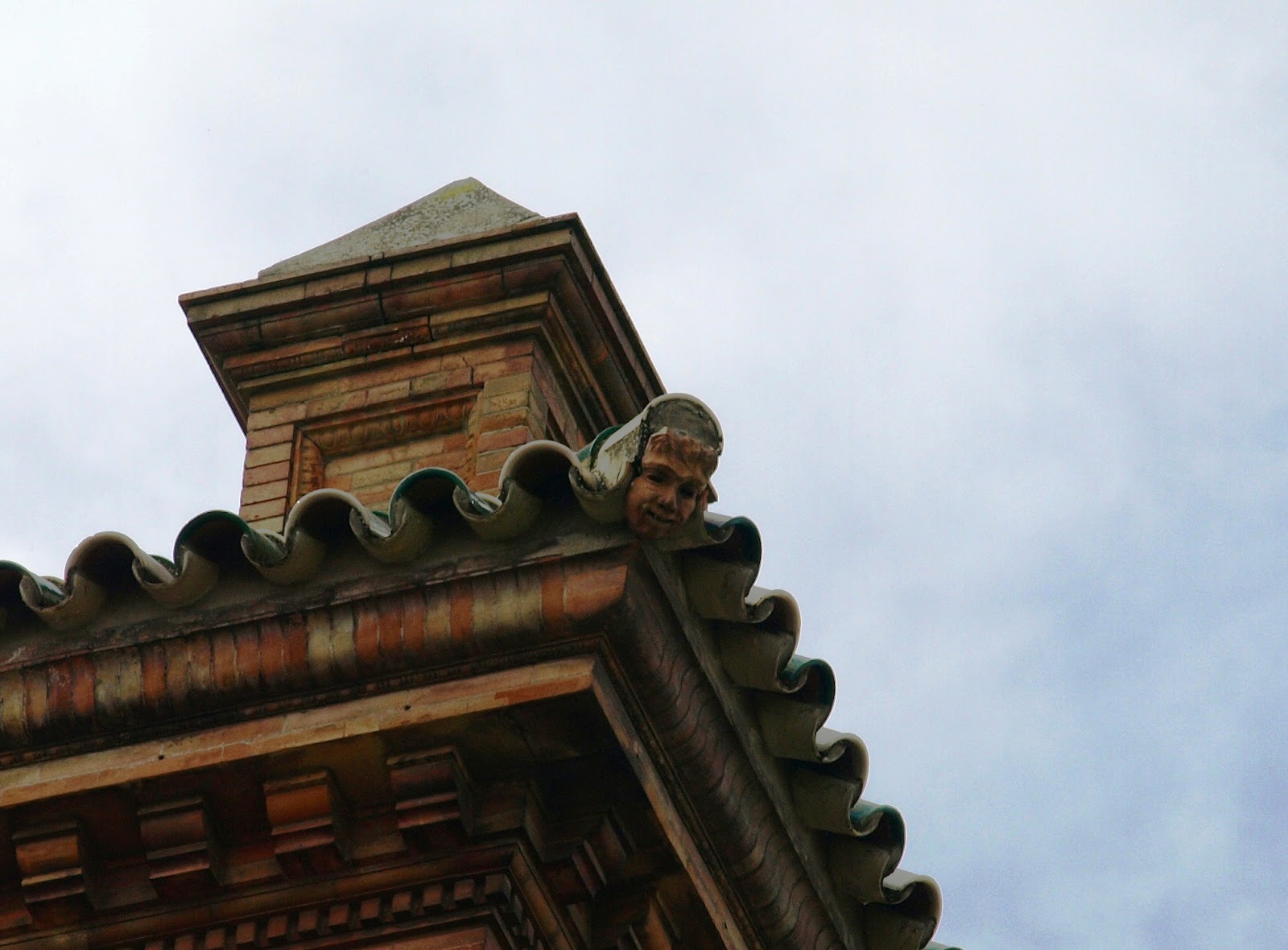
Hace algunos meses, un amigo de este blog, nos remitió un email preguntándonos por unas pequeñas imágenes de rostros que aparecían en el tejado de las torres-miradores del Teatro Coliseo.
La verdad es que, hasta entonces, este detalle se nos había pasado inadvertido por lo que tuvimos la curiosidad de ir a verlo y tomar detalles de los mismos.
Ahora podemos decir que, teniendo en cuenta el edificio que están situados, parecen máscaras de teatro.
O, al menos que alguien más versado en la historia de este edificio nos corrija e ilumine, eso es lo que podemos intuir.


A few months ago, a friend of this blog sent us an e-mail wondering for a few small images of faces that were appearing in the roof of the towers of the Coliseo Theatre.
The truth is that, till then, we didn´t know this detail and we decide to go to see it.
Now we can say that, bearing in mind the building that they are placed, they look like theatre masks.
Or, I hope that someone who knows the history of this building corrects and illuminates to us if this is not true.

jueves, 31 de marzo de 2011

El hombre de piedra.


Entre las calles Jesús del Gran Poder y Santa Clara hay una calle estrecha llamada Calle del Hombre de Piedra". Debe su nombre a un torso de estatua romana situado en un nicho entre las casas nº 10 y 12.
Antaño estuvo embutido en la pared, empleado como botarruedas. Aunque está muy desgastado, todavía se puede reconocer la forma de un tronco humano desnudo con una toga rodeando su cintura.
Sin embargo, la leyenda dice otra cosa.
Un tal Mateo el rubio, allá por el siglo XV estaba dándole condumio líquido a la calle del trago con unos compadres por las tabernas de la Calle del Buen Rostro cuando el Santísimo en procesión se detuvo justo delante de su figura.
Por aquel entonces, la Ley XI del Rey Don Juan obligaba a postrarse de rodillas ante el Santísimo en cualquier momento y en cualquier lugar. Todos los reunidos lo hicieron a excepción de Mateo el Rubio quien se rió de todos los demás.
Dice la leyenda que un rayo divino cayó sobre él, hundiéndole las rodillas que no quiso doblar en la tierra, y convirtiéndolo en piedra.
.
Between the streets called "Jesus del Gran Poder" and "Santa Clara" there is a narrow street called "Street of the Man in Stone". This name owes to a torso of Roman statue placed in a niche between the houses n º 10 and 12.
Long ago it was stuffed into the wall, used like rollguards. Though it is very spoiled, still it is possible to recognize the form of a human nake trunk with a toga surrounding his waist.
Nevertheless, the legend says another thing.
Such a Mateo the blond, as far back as the 15th century was taking wine with a few godfathers for the taverns of the Street of the Buen Rostro when the Holiest in procession stopped rightly in front of his figure.
In those days, the XIth Law of the King Don Juan was forcing to prostrating itself on knees before the Holiest at any time and in any place. All the assembled ones did it with the exception of Mateo Blond who laughed at all those who did it.
The legend says that a divine beam fell on him sinking the knees that he did not want to double in the land and turning it into stone.

miércoles, 30 de marzo de 2011

La Capilla de los Humeros.


La Capilla de Nuestra Señora del Rosario, o Capilla de los Humeros, está situada en la calle Torneo, la portada de la capilla se organiza en dos cuerpos. En el primero, dos pilastras y un frontón curvo partido enmarcan el vano de medio punto.
En el lugar del tímpano, surge la base de la hornacina que forma el segundo cuerpo, donde se halla una bella y expresiva imagen de terracota de Nuestra Señora del Rosario.
A pesar de tener sólo doce metros de largo por cinco de ancho, es una de las joyas del barroco sevillano y una capilla bastante poco conocida y transitada.
En su interior se guardan reliquias de Santo Domingo de Guzmán y Santa Catalina de Siena.
.
The Chapel of Our Lady of the Rosario, or Chapel of the Humeros, is placed in Torneo Street, the front wall of the chapel is organized in two bodies. In the first one, two pilasters divided the half a point arch.
There is a niche that forms the second body, where it is situated a beautiful and expressive image made in terracotta of Our Lady of the Rosario.
The chapel has just twelve meters of length and five of width and it is one of the jewels of the Sevillian baroque but it is not enough known and travelled chapel by the people.
In the interior area they guard relics of Saint Domingo of Guzman and Holy Catalina de Siena.

martes, 29 de marzo de 2011

La Casa de Santa Teresa.


Existe en la Calle Zaragoza un edificio que recuerda bien a un antiguo convento, bien a una antigua casa-palacio. En realidad es ambas cosas.
En esta casa, como indica una placa en la pared en el zaguán de entrada, moró Santa Teresa de Jesús y las primeras monjas de su congregación a los pocos años de instaurarla.
La estructura y apariencia externa era diferente a la actual, pues, con el paso de los años, los siguientes propietarios así lo hicieron para adecuarlo a sus necesidades. La apariencia actual se debe al arquitecto Vicente Trever quien en 1880 recibió el encargo de rediseñarla.
En el "Libro de las Fundaciones" de la Santa se explica lo que ocurrió. El Convento de Sevilla fue el undécimo que constituyó con cuatro monjas de los conventos de Malagón, Medina y Toledo el 25 de mayo de 1575.Cuatro días después, el 29 de dicho mes, se ponía el Santísimo Sacramento y quedaba establecida la Fundación.
Al establecerse las monjas en una casa alquilada, la Santa no quiso marcharse de Sevilla hasta dejar a la comunidad en casa propia, por lo que estuvo aquí todo un año hasta el 4 de junio de 1576, después que se hubo hecho el traslado a la calle Pajerías, hoy calle Zaragoza. 
Diez años después, el 11 de junio de 1576, buscando un lugar de más retiro y no tan bullicioso como lo era la proximidad al embarcadero de Indias, la comunidad se trasladó al edificio actual en el Barrio de Santa Cruz, asistiendo al traslado y contribuyendo a él San Juan de la Cruz.


In Zaragoza Street exists a building that he remembers or to a former convent, or to a former house-palace. Really it was both things.
In this house, like indicates a ceramic plate in the wall in the vestibule of entry, here Holy Teresa de Jesus and the first nuns of his congregation lived to a few years of restoring it.
The structure and external appearance was different from the current one, so, like the years went by, the following owners adapted it to their needs. The current appearance owes to the architect Vicente Trever who in 1880 received the order for redesign it.
In the " Book of the Foundations " of Holy Teresa is explained what happened. The Convent of Seville was the eleventh one and it constituted with four nuns of Malagón's convents, Medina and Toledo on May 25, 1575. Four days later, 29 of the above mentioned month, it was putting on the Holiest Sacramento and the Foundation was remaining established.
When the nuns established in a rented house, Holy Teresa did not want to leave of Seville up to stopping to the community in own house, for what it was here the whole year until June 4, 1576, later that had done the movement to themselves to the Pajerías Street, today Zaragoza Street.
Ten years later, on June 11, 1576, looking for a place with proximity to the pier of The Indies, the community moved to the current building in the Neighborhood of Santa Cruz.

lunes, 28 de marzo de 2011

Y no es Venecia.


Hacía más de diez años que esta atracción acuática había desaparecido de los canales de la Plaza de España.
Sin embargo, a finales del año pasado, tras una labor de limpieza y adecentado, la ciudad pudo volver a ver navegar a las barcas por los quinientos metros de largo que tiene la ría de la Plaza de España.
Este edificio de la Plaza de España fue creado para la Exposición Iberoamericana de 1929. Entonces, las embarcaciones que navegaban por el agua eran similares a las góndolas venecianas. Duraron poco.
Posteriormente, fueron sustituidas por las más tradicionales barcas de remo y motor de nuestra tierra.
.
It was doing more than ten years that this aquatic attraction had eliminated of the channels of the Spain Square Building.
Nevertheless, at the end of last year, after a labor of cleanliness and tidied, the city could return to see to sail to the boats along five hundred meters of length that has the little river of the Spain Square.
This building  was built for the 1929 Latin-American Exhibition. Then, the crafts that were sailing along the water were similar to the Venetian gondolas. They were here for a short time.
Later, they were replaced with the most traditional boats of our land.